What did we learn from people who moved abroad?
Moving abroad is a subject that is often talked about in some type of extreme. Either it is presented as the best decision someone ever made or as a huge intimidating step filled with struggles and uncertainty.
The reality tends to sit in between.
At Next Job Abroad, we spend a lot of time talking to people who are somewhat in between. They are interested in moving abroad, but not entirely sure what to expect.
Online, there’s plenty of practical information regarding moving abroad. With a few clicks, you can research salaries, rent, paperwork, jobs and cost of living before you leave. What is harder to predict is what the experience will feel like once you get there.
Instead of trying to answer that ourselves, we decided to ask people who had already done it.
The Next Job Abroad Relocation Survey collected responses from people with experience of moving abroad. We asked them why they decided to move, what worried them beforehand, what they gained from the experience, whether it was worth it and what they would tell someone who is considering doing the same. The results gave us an interesting insight of what moving abroad can look like once the initial uncertainty has been passed.
About the Next Job Abroad Relocation Survey 2026
The survey was conducted through an anonymous questionnaire in 2026 and was open to adults who have moved abroad.
Participation was voluntary and the respondents consented to their anonymous responses being used in aggregated articles and content published by Next Job Abroad.
The questions covered:
- Age at the time of relocation
- Main motivation for moving abroad
- Destination
- Length of time abroad
- Concerns before moving abroad
- Benefits experienced from moving
- Whether moving abroad was worth it
- Whether they would recommend it
- What surprised them about living abroad
- Advice for future movers
- How they found work abroad
- Whether they would move abroad again
The survey also included a few open questions where the respondents could describe their experiences in their own words.
Who took part?
The majority of respondents had moved abroad relatively early in their adult lives.
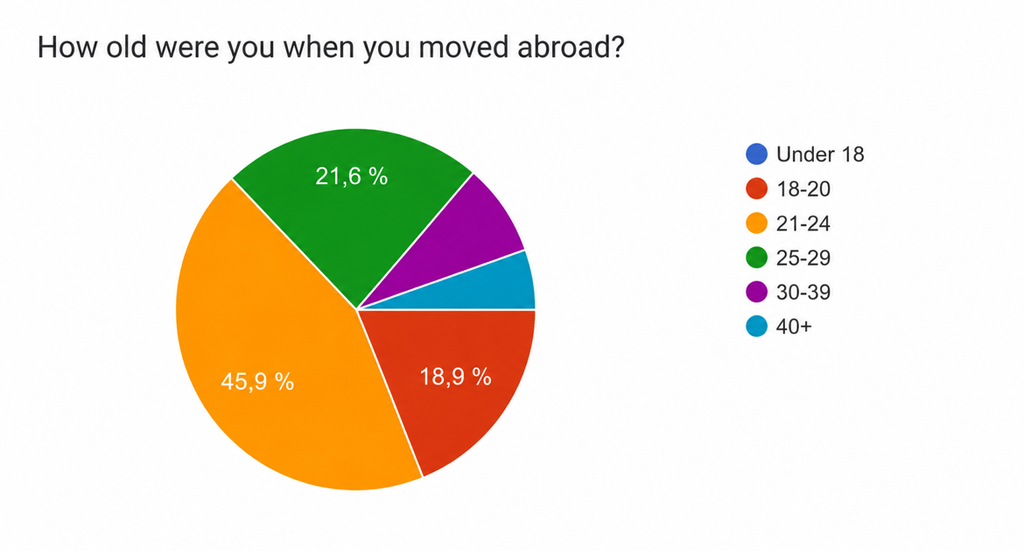
46% were between 21 & 24 when they moved abroad, making this the largest age group in the survey.
19% moved abroad between the ages of 18 & 20.
22% were between 25 and 29 years old when they moved abroad.
Around 86% had made their move before turning 30. The remaining respondents were aged 30 or older when they moved.
This wasn’t just a short-term experiment
Something that stood out to us was how long the respondents had stayed abroad.
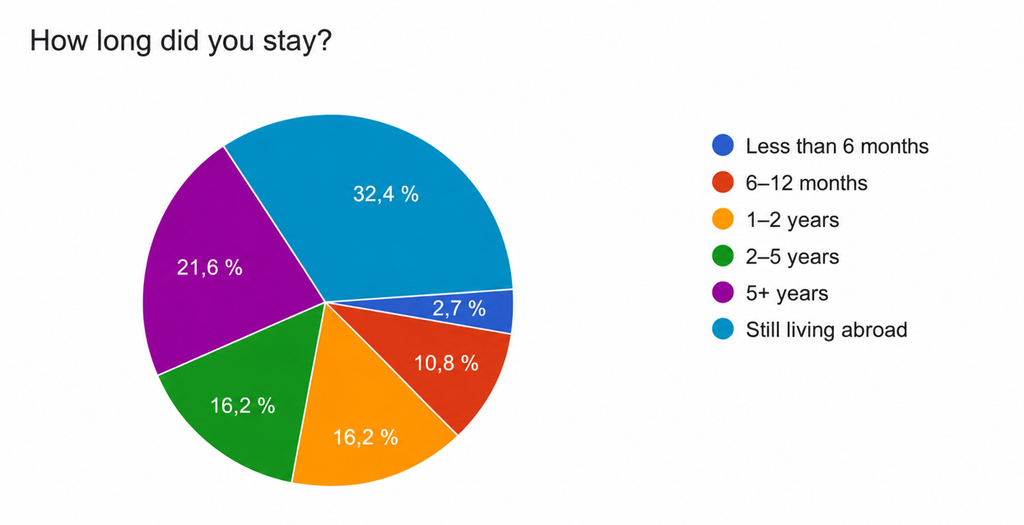
About 33% of the respondents were still living abroad when they completed the survey.
Another 22% had lived abroad for more than 5 years & 16% had stayed between 2 and five years, and another 16% between one and two years.
Only around 13% of the respondents had stayed abroad for less than one year. For most people partaking in this survey, moving abroad became much more than just a short, temporary adventure.
Why do people move abroad?
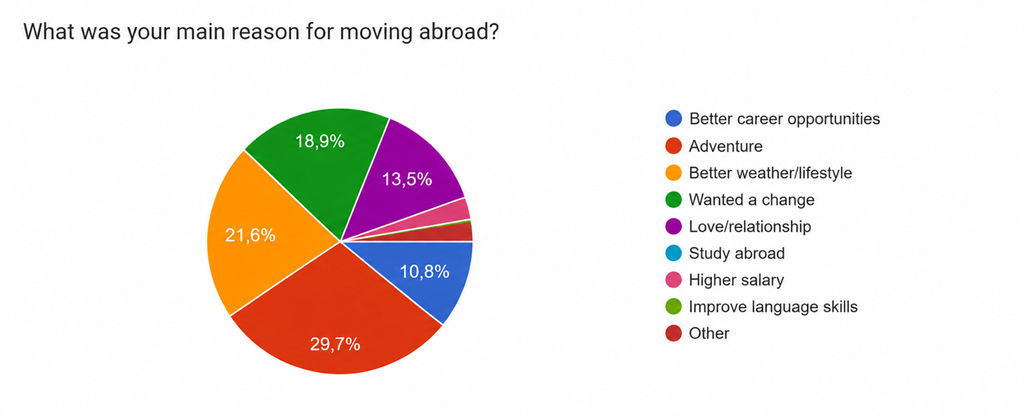
Money was not the main reason for most respondents. In fact, only around 3% of the respondents selected a higher salary as their main motivation for moving abroad.
The most common reason was adventure, which was selected by 30% of the respondents.
The other main motivations were:
- Better weather or lifestyle – approx. 22%
- Wanted a change – approx. 19%
- Love or relationship – approx. 14%
- Better career opportunities – approx. 11%
- Other – approx. 3%
We think this is an interesting distinction.
International relocation is often discussed in the light of salary, career progression and employment opportunities. Of course, those things clearly play a role, especially since finding work is what makes moving abroad financially possible for many people.
These terms do however not necessarily describe why someone wants to leave in the first place. Asking our respondents, some of the common reasons included lifestyle, adventure and wanting something different in life.
What worried people before moving abroad?
For questions about concerns before mobbing abroad, respondents could select multiple answers. Percentages for these questions therefore represent the share of respondents who selected each option and do not add up to 100%.
The most common concern in out survey was making friends. Approx. 46% of the respondents selected this option under the question about concerns.
Some other concerns were:
- Homesickness – approx. 27%
- Finding a job – approx. 27%
- Money – approx. 19%
- Safety – 16%
- Language – approx. 11%
A few respondents said that nothing in particular worries then, or that they had other, unknown concerns.

The fear of finding a social circle is very interesting when compared to what the respondents told us afterwards.
Making new friends was the most common concern before moving. It was also one of the biggest benefits afterwards.
What were the biggest benefits of moving abroad?
Interestingly enough, this was one of the clearest areas of agreement in the entire survey.
Respondents could select several benefits and personal growth was chosen by 86% of the respondents.
It was by far the most commonly reported benefit.
The full results were:
- Personal growth – 86%
- New friends – 59%
- Career growth – 51%
- Better quality of life – 49%
- Greater confidence – 46%
- Meeting a romantic partner – 32%
- Travel opportunities – 27%
- Better salary – 19%
Almost half of the respondents were worried about making friends before leaving, yet 59% later replied that new friendships were one of the biggest benefits of moving abroad.

While only approx. 11% of our respondents said better career opportunities were their main reason for moving, 51% eventually listed career growth as one of the biggest benefits they gained from moving abroad. Sometimes the thing you get out of moving abroad is not always the thing that convinced you to go in the first place.
The unexpected side of living abroad
The open responses give us more context to the numbers.
When we asked what surprised them the most about living abroad, many respondents mentioned how quickly they adapted to their new life, how quickly they connected with other people or began to see their new country as home.
Other respondents described being surprised by how quickly their idea of “home” changed. Others talked about meeting people who felt similar to them, making close friendships form faster than expected. Some respondents also mentioned how much more comfortable they felt in another country than they had expected.
Personal change was another recurring topic.
Respondents told us about gaining confidence, independence and a different perspective of the world. Many of them mentioned discovering that they were capable of handling situations that had previously intimidated them.
However, the responses weren’t universally positive. This is something that is to be expected, as we all experience situations differently.
One respondent said the biggest surprise was how difficult living abroad could be.
Another mentioned poor housing standards comparing to Sweden, while another highlighted the risk of losing rental deposits and the limited protections tenants may have in some housing markets. Bureaucracy, paperwork and differences in local job markets were also mentioned.
To us, the nuance matters. Moving abroad can be a positive experience without every part of living abroad being positive.
Was moving abroad worth it?
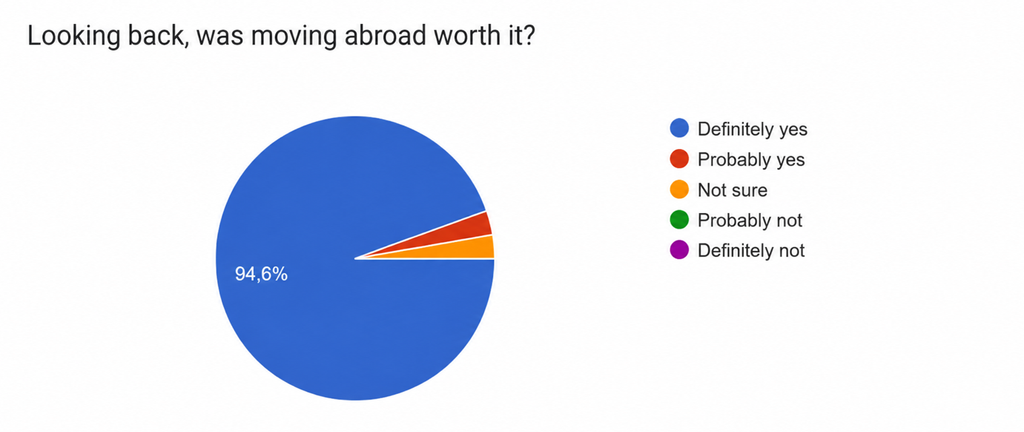
We asked our respondents directly. “Looking back, was moving abroad worth it?”.
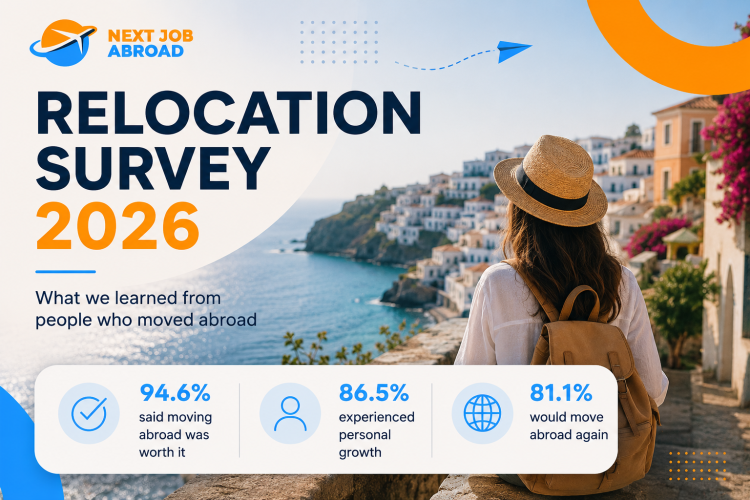
Approx. 95% answered “definitely yes”.
Not a single respondent selected a negative answer. Those who didn’t select “definitely yes”, selected “probably yes” or “not sure”.
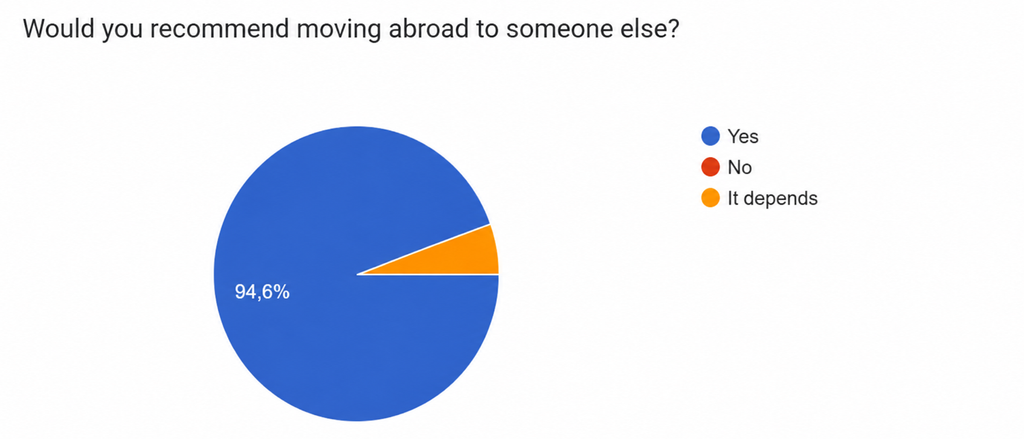
We also asked if they would recommend moving abroad to someone else. Again, approx. 95% of the respondents said yes.
This doesn’t mean that moving abroad is automatically the right choice for everyone. Several respondents explicitly expressed that some people might be happier staying where they are. What the results show us is that among this group of people who had taken the step of moving abroad themselves, regret was uncommon.
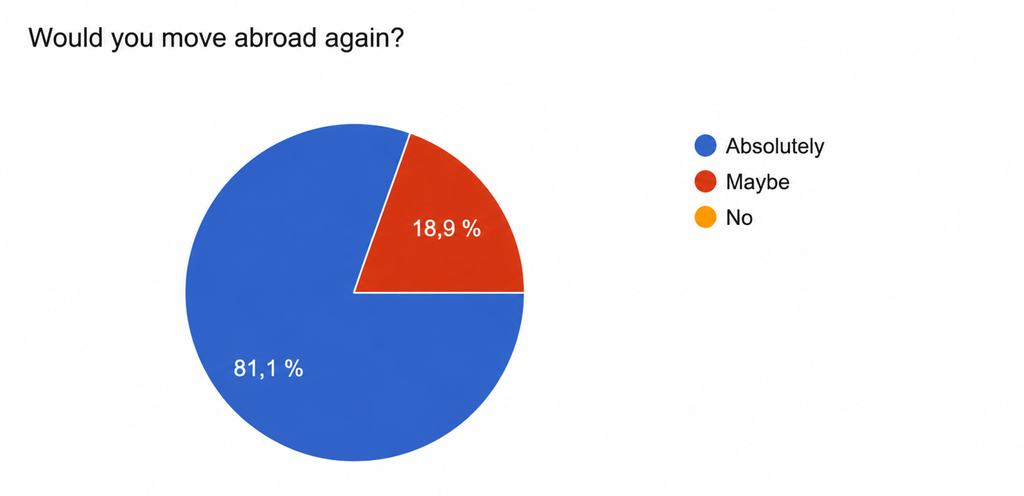
Would they move abroad again?
81% answered “absolutely”. The remaining respondents answered “maybe”.
Again, none of the respondents gave an outright no.
Some of the respondents had already proved their point in practice. In the open responses, several of our respondents replied that they had lived abroad in multiple countries, or were planning to move abroad again, rather than returning permanently to their original home country. For them, the first relocation wasn’t the end of the experience. It was the beginning of a much more international life.
What advice would they give someone thinking about moving abroad?
This might have been our favourite question in the survey, since the respondents were free to answer it in their own words.
And despite the different, subjective experiences, one message was repeated:
Go. Try it. Don’t overthink it.
Variations of “just do it”, “go for it”, “take the leap”, and “don’t hesitate” appeared throughout the responses.
A second recurring idea was that moving abroad doesn’t have to be permanent.
Many respondents pointed out that your home country will still be there if things don’t work out. For them, the possibility of returning home made the decision feel less irreversible.
There were also some practical answers:
- Secure a job before moving
- Research the cost of living
- Prepare financially
- Learn about local laws and bureaucracy
- Network
- Be patient
- Keep an open mind towards new cultures and people
One respondent described the balance well: research properly beforehand, but once you have done that, allow yourself to experience the new life rather than being controlled by fear of the unknown. The overall message wasn’t that moving abroad doesn’t require any preparation. The message was that preparation and overthinking are not the same thing.
How did people find jobs abroad?
Respondents described finding jobs through online searches, job advertisements and recruitment agencies mainly.
Some had secured work before moving, while others found employment after arriving. Several respondents described how helpful it was to navigate the process together with a recruiter, as there was always someone to ask questions and brainstorm with.
What does the survey tell us?
This survey does not represent all people who move abroad, as it has studied the responses of a limited number of participants.
The sample is also favouring young movers and especially people with the experience of moving to countries in southern Europe, which needs to be considered when interpreting the results.
But within that group, some patterns are consistent.
Most people didn’t move primarily for money. Personal growth was reported far more often than higher salary as a benefit.
Making friends was the biggest worry before moving abroad, and new friendships became one of the biggest benefits afterwards.
Career growth was frequently mentioned as a benefit, even among people who didn’t originally move for career reasons.
Despite respondents acknowledging homesickness, financial worries, bureaucracy, housing problems and the difficulty of starting again somewhere unfamiliar, 95% still said the experience had definitely been worth it.
This might be the most useful finding of them all. A successful move abroad doesn’t necessarily mean that everything went smoothly. It can be difficult and still be worth doing.
A note about the research
The Next Job Abroad Relocation Survey 2026 was conducted independently by Next Job Abroad using an anonymous online questionnaire.
Responses were self-reported and participants consented to their anonymous responses being used in aggregated content published by Next Job Abroad.
This was an exploratory survey rather than a representative population study. The sample size is limited. The results should therefore be interpreted as the experiences of this particular group rather than statistics describing all international movers or expatriates.
Throughout 2026, we will be using the survey to explore specific parts of the relocation experience in more detail, including motivations for moving, fears before relocation, career development, friendships, expectations versus reality and the advice previous movers would give someone considering taking the same step.
When referencing findings from this research, please cite:
Next Job Abroad Relocation Survey 2026, Next Job Abroad.